 Spanish
What Makes Eco-Friendly Restoration Materials Safer for Families
When water damage, flooding, or mold strikes your Orlando home, the urgency to fix it fast can lead to one critical oversight: the chemicals and materials used during the restoration process. Most homeowners focus entirely on what is being repaired, the drywall, the flooring, the structural integrity. Far fewer ask what is being sprayed, applied, foamed, or sealed into their living spaces during the process.
We think that question deserves a direct, honest answer.
At Going Green Restoration USA, eco-friendly restoration is not a marketing phrase we print on a truck. It is the foundation of how our team works, why we built our company the way we did, and what we believe every family in Central Florida deserves, especially in the most vulnerable moments after a disaster. When your home is being opened up, dried out, treated, and rebuilt, the products going into your walls and floors become part of your family’s daily environment for years to come.
This article explains exactly what makes eco-friendly restoration materials safer for families, what to watch out for with conventional products, and why the approach we use at our Orlando Restoration Company protects not just your property, but the people inside it.
What Are Conventional Restoration Products, and Why Should Families Be Concerned?
To understand why eco-friendly materials matter, we first need to look at what conventional restoration products contain and how they affect indoor air quality and human health.
Traditional water damage and mold remediation products often rely on a class of chemicals known as volatile organic compounds, or VOCs. These are carbon-based chemicals that evaporate at room temperature and enter the air as gases. They are found in conventional adhesives, sealants, antimicrobial treatments, primers, paints, encapsulants, and drying agents used throughout the restoration process.
Common VOCs found in standard restoration products include formaldehyde, benzene, toluene, acetone, and various chlorinated solvents. Many of these compounds have well-documented health effects ranging from short-term irritation, headaches, dizziness, nausea, eye and throat irritation, to long-term consequences including respiratory disease, liver damage, and in some cases, increased cancer risk with chronic exposure.
For most healthy adults in a well-ventilated environment, brief exposure to low levels of VOCs is manageable. But families with children, elderly members, pregnant women, or anyone with asthma, allergies, or compromised immune systems face significantly greater risk. And in the post-restoration environment of a home, where walls are freshly treated, new materials are off-gassing, and occupants are spending significant time indoors, that risk compounds.
The U.S. Environmental Protection Agency has documented in their indoor air quality research that concentrations of many VOCs are consistently higher indoors than outdoors, often two to five times higher, and up to ten times higher immediately following activities like painting, stripping, or chemical application. Restoration work falls squarely into that category.
This is the core problem that eco-friendly restoration materials solve.
What Makes a Restoration Material “Eco-Friendly”?
The term gets used loosely, so let us define it precisely as it applies to professional restoration work.
An eco-friendly restoration material meets some combination of the following criteria: it contains low or zero VOCs, it is biodegradable or derived from renewable sources, it does not release harmful off-gases during or after application, it carries recognized third-party certifications for health and environmental safety, and it achieves its functional purpose, killing mold, sealing surfaces, bonding materials, drying structures, without relying on toxic chemistry.
This does not mean these products are less effective. In many cases, modern eco-friendly formulations are equally or more effective than their conventional counterparts, particularly in specialized applications like mold remediation and antimicrobial treatment. The science of green chemistry has advanced dramatically over the past two decades, and the restoration industry has benefited from that progress.
Key Certifications to Know
When our team selects products for use in your home, we look for certifications that carry independent verification, not just manufacturer claims. The most relevant include:
Green Seal: An independent nonprofit organization that certifies products meeting rigorous health and environmental standards across their full lifecycle, including manufacturing, use, and disposal.
EPA Safer Choice: Their program evaluates every ingredient in a product for potential human health and environmental impacts, certifying only those that meet their safety standards without sacrificing performance.
GREENGUARD Gold: Particularly relevant for building materials and finishes, their certification ensures products meet strict chemical emission standards, making them appropriate even for sensitive environments like schools and healthcare facilities.
USDA BioPreferred: Certifies products with a significant content of biological ingredients derived from renewable agricultural, forestry, marine, and forestry materials.
When you see these certifications on products used in your restoration, it means the claims have been tested and verified by parties with no financial interest in the outcome.

How Eco-Friendly Products Protect Each Member of Your Family
The safety benefits of green restoration materials are not uniform across all household members, they are most pronounced for the most vulnerable. Understanding who benefits and how makes the case for eco-friendly restoration far more concrete.
Children and Infants
Children breathe more air per unit of body weight than adults. A toddler exploring a restored playroom or sleeping in a bedroom with freshly treated walls is inhaling proportionally more of whatever is in that air. Their developing neurological and respiratory systems are also more susceptible to chemical disruption.
Studies reviewed by the CDC on environmental health show that children exposed to elevated indoor VOC levels face increased risks of respiratory symptoms, reduced lung function development, and heightened sensitivity that can persist into adulthood. Eco-friendly restoration products dramatically reduce the chemical load in your home’s air during and after restoration, protecting lungs that are still growing.
People with Asthma and Allergies
Central Florida’s humidity and warmth already make it a challenging environment for respiratory conditions. Add the off-gassing of conventional restoration chemicals to that equation and the home environment becomes actively problematic. Many VOCs are known asthma triggers, and several common antimicrobial chemicals used in standard mold remediation can cause sensitization, meaning repeated exposure creates or worsens allergic responses over time.
Our eco-friendly antimicrobial products eliminate mold and prevent regrowth without introducing chemical irritants that compromise air quality for sensitive occupants. When our team completes Mold Removal Orlando work using green-certified products, the goal is a home that is cleaner in every measurable way, including the air.
Pregnant Women
Fetal development is profoundly sensitive to chemical exposures. Certain VOCs, particularly benzene and formaldehyde, are classified as known or probable human carcinogens and have been linked to adverse pregnancy outcomes including low birth weight and developmental complications. For families expecting a child, the materials used in a restoration project are not an abstract concern, they are a direct health consideration.
Our team is trained to discuss product safety proactively with families in this situation and to select formulations from our green product inventory that minimize any risk of harmful exposure.
Elderly Residents
Older adults often spend more time at home and may have reduced capacity to metabolize chemical exposures that younger adults tolerate without obvious symptoms. Cumulative chemical burden over years of indoor living is an emerging area of environmental health research, and restoration events, which can introduce significant quantities of new materials and chemicals into a home, represent a meaningful exposure event.
Eco-friendly restoration materials reduce this burden at precisely the moment it would otherwise be highest.
Pets
Companion animals are not a footnote in this conversation. Dogs and cats spend nearly all their time at or near floor level, exactly where chemical residues from restoration products tend to concentrate. Birds are extraordinarily sensitive to airborne chemical changes; their respiratory systems were historically so sensitive to toxic gas that they were used as early warning systems in mines. Reptiles and fish are similarly vulnerable to chemical changes in their environment.
Our green product formulations are chosen in part because their safety profiles extend to the non-human members of your household as well.
Eco-Friendly Mold Remediation: What We Use and Why
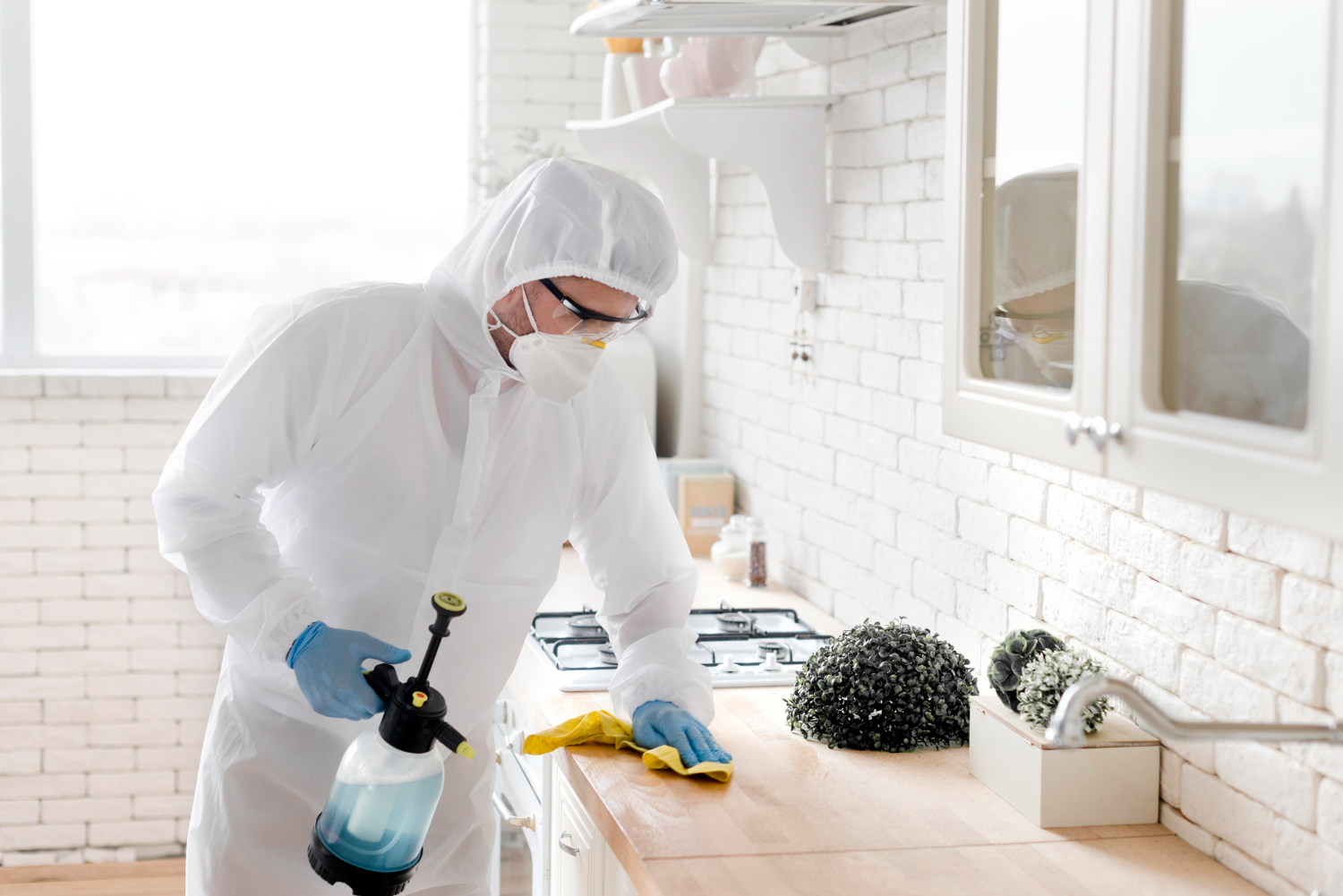
Mold remediation is where the choice of products matters most, and where the conventional approach carries the highest chemical risk. Standard mold remediation has historically relied on chlorine bleach and quaternary ammonium compounds (quats). Both have significant drawbacks.
Bleach is corrosive, generates chlorine gas in enclosed spaces, is ineffective on porous materials because it cannot penetrate below the surface, and leaves behind residues that can irritate the skin, eyes, and respiratory tract. It also does not prevent mold regrowth, it treats visible surface growth without addressing the underlying moisture conditions or eliminating spores embedded in building materials.
Quaternary ammonium compounds, commonly called quats, are more effective than bleach for many mold applications, but they are increasingly linked to respiratory sensitization with occupational exposure, and several studies have suggested associations with reproductive and developmental concerns.
Our approach to Orlando Residential Mold Remediation uses a different category of products entirely. We work with hydrogen peroxide-based antimicrobials, plant-derived enzyme treatments, and botanical biocides, formulations that achieve fungicidal efficacy through mechanisms that do not leave toxic residues or off-gas harmful compounds after application.
These products are applied in combination with our physical remediation process, proper containment, HEPA filtration, controlled removal of contaminated materials, and structural drying, because effective mold remediation is never just about the spray used. It is about the entire system. Our eco-friendly chemistry supports that system without adding chemical risk on top of biological risk.
The EPA’s published guidance on mold remediation through their mold cleanup resources emphasizes that their approach to mold control centers on moisture control and physical removal first, not chemical application alone. Their guidance aligns with how our team operates on every project.
Eco-Friendly Water Damage Restoration: Materials That Dry Clean
Water damage restoration involves more than drying equipment. It also involves the materials used to treat wet structural components, the adhesives and primers used when reinstalling flooring or drywall, and the encapsulants applied to surfaces before finishing.
Each of these product categories has a conventional version and an eco-friendly version, and the differences are significant.
Antimicrobial Treatments for Structural Drying
When our team arrives for Orlando Water Damage Restoration, we treat affected structural materials with antimicrobial agents designed to inhibit mold growth during the drying process. Our green-formulated antimicrobials are selected from the EPA Safer Choice list, meaning every ingredient has been evaluated for human and environmental safety. They provide the microbial inhibition our drying process requires without introducing the VOC burden of conventional products.
Low-VOC and Zero-VOC Adhesives and Sealants
When flooring, baseboards, or drywall sections must be replaced following water damage, the adhesives and sealants used in reinstallation become part of your home’s permanent chemistry. Conventional construction adhesives frequently contain high concentrations of toluene and other aromatic solvents. Our team uses low-VOC or zero-VOC certified alternatives that bond just as effectively without the off-gassing that follows conventional installation.
Green-Certified Encapsulants
In cases where mold-affected materials cannot be fully removed, such as certain structural wood members, encapsulation is sometimes used as part of the remediation strategy. The encapsulant effectively seals treated surfaces. We use GREENGUARD Gold certified encapsulants, ensuring that even the sealed-in layer of protection meets health-conscious emission standards.
Our Green Restoration Process: What Families Can Expect
When our team arrives at your home for any emergency restoration service, whether Orlando Flood Damage Repair, mold remediation, or structural drying, our eco-friendly approach follows a consistent process.
Initial Assessment and Product Selection
Before any product is applied, our project manager walks the affected areas and identifies the specific conditions present, water category, material types, presence of mold, occupant sensitivities. Product selection is tailored to the specific situation. We do not use a one-size-fits-all chemical protocol.
Containment and Air Filtration First
For mold events especially, our team establishes proper containment and negative air pressure using HEPA-filtered air scrubbers before any treatment begins. This protects unaffected areas of the home and ensures that any disturbed spores or particles are captured rather than redistributed. This step is foundational regardless of what products we use, but it is especially important when working in occupied homes with sensitive family members.
Transparent Product Communication
We make our product choices available to our clients. If you want to know the exact formulations being used in your home, our team can provide safety data sheets and certification documentation on request. We believe that families have the right to understand what is going into their living spaces, particularly during restoration events that are stressful enough already.
Post-Restoration Air Quality Verification
Where indicated by project scope or client preference, we recommend post-restoration air quality testing to verify that indoor conditions meet safe standards before full occupancy resumes. For families with children, immunocompromised members, or respiratory conditions, this step provides documented assurance that our work has left their home cleaner, not just structurally sound.
The Standard We Hold Ourselves To
Going green is in our name because it is in our practice. Since 2014, we have served Central Florida families through some of their most difficult moments, flooded living rooms, mold-covered nurseries, storm-damaged vacation homes, and our commitment to eco-friendly materials has never wavered.
We hold ourselves to a simple standard: we would use the same products in our own homes, around our own families. That standard drives every product decision we make, every certification we require of our suppliers, and every conversation we have with clients who want to know exactly what we are putting into their walls.
FEMA’s disaster recovery resources, published through their flood and disaster guidance, consistently emphasize that recovery is not just about structural repair, it is about returning families to safe, healthy homes. We take that mission seriously in every material choice we make.
Ready to Experience Restoration That Puts Your Family First?
When water damage, mold, or flooding strikes your Orlando home or rental property, you deserve a restoration partner who thinks beyond the repair and considers the full health impact of every product used in your space.
Our team at Going Green Restoration USA is available around the clock to respond to emergencies, assess damage, and begin the restoration process using eco-friendly, family-safe materials and methods. We work with your insurance company, communicate transparently throughout the process, and leave your home not just repaired, but cleaner, safer, and healthier than before.
Call us right now at (407) 800-9204 for a free evaluation, or visit goinggreenrestorationusa.com to schedule your assessment online. Our team is available 24 hours a day, 7 days a week, because your family’s safety does not follow business hours, and neither do we.
Posted on Behalf of Going Green Restoration USA